
For laboratories
An interpretation layer for your laboratory panels
STRUCTA MED turns a panel of results into a structured, explainable reading for the clinician: what is outside range, which findings belong together, and what to review first. Rule-based, with the reasoning shown for every finding.
- Submitted results are not stored
- Encrypted in transit; processed in the EU (Frankfurt)
- No AI is called on the partner API
- Never sold, no ads, no other use without consent
- We recommend sending de-identified data only
What your laboratory gets
Integration
Send structured results as JSON to a REST endpoint, POST /api/v1/analyze, with your API key. You receive the interpretation as JSON: findings with their reasoning, patterns, next steps, trends and the list of unrecognised rows. Branded PDF reports are available in the web application. POST /api/v1/report returns a branded PDF report. Results can also be sent with LOINC codes (214 supported codes): rows are routed by code, with name matching as a fallback.
POST /api/v1/analyze
Authorization: Bearer sm_live_...

{
  "patient": { "sex": "male", "age": 45 },
  "results": [
    { "name": "ApoB", "value": 1.32, "unit": "g/L",
      "ref_low": 0.6, "ref_high": 1.0 },
    { "name": "ALT", "value": 22, "unit": "U/L", "ref_high": 50 }
  ]
}{
"engine_version": "structamed-engine/2026-10",
"counts": { "received": 2, "graded": 2, "abnormal": 1 },
"findings": [
{ "name": "ApoB", "value": 1.32, "unit": "g/L",
"ref_source": "partner", "status": "high",
"severity": "warning", "rationale": [ ... ] },
...
],
"patterns": [ ... ],
"next_steps": { "urgency": "routine", "steps": [ ... ] },
"unrecognized": []
}API access
We issue one API key per laboratory after you contact us. The key is sent to you once. Only a hash of it is stored on our side, so a lost key is replaced, not recovered.
Check your export before go-live
POST /api/v1/recognize takes the same API key and the same request body as analyze. It runs no analysis: it reports how your rows are recognised.
- You see how many rows arrived, how many carry no result value, and how many were resolved by each stage: your own dictionary, the code (LOINC), or our global marker names.
- Rows that were not recognised come back with the reason and with suggestions of the closest catalogue entries. Suggestions are hints and are never applied automatically.
- It needs an API key like the other endpoints. It is not metered: it does not count as a report and the monthly allowance does not apply.
{
  "request_id": "req_...",
  "recognition": {
    "total_rows": 5,
    "by_source": { "partner_dictionary": 1, "code": 1,
                   "global": 2, "none": 1 },
    "no_value": 0,
    "unresolved": [
      { "name": "Xyz", "reason": "marker name is not recognized",
        "suggestions": [ { "domain": "results", "key": "...", "label": "..." } ] }
    ]
  }
}
Your codes, no development
Each laboratory has its own dictionary that maps your internal test codes and printed names to our markers. You send your codes and names as they are; the mapping is configuration on our side, not code.
5 data types, one clinician-first report
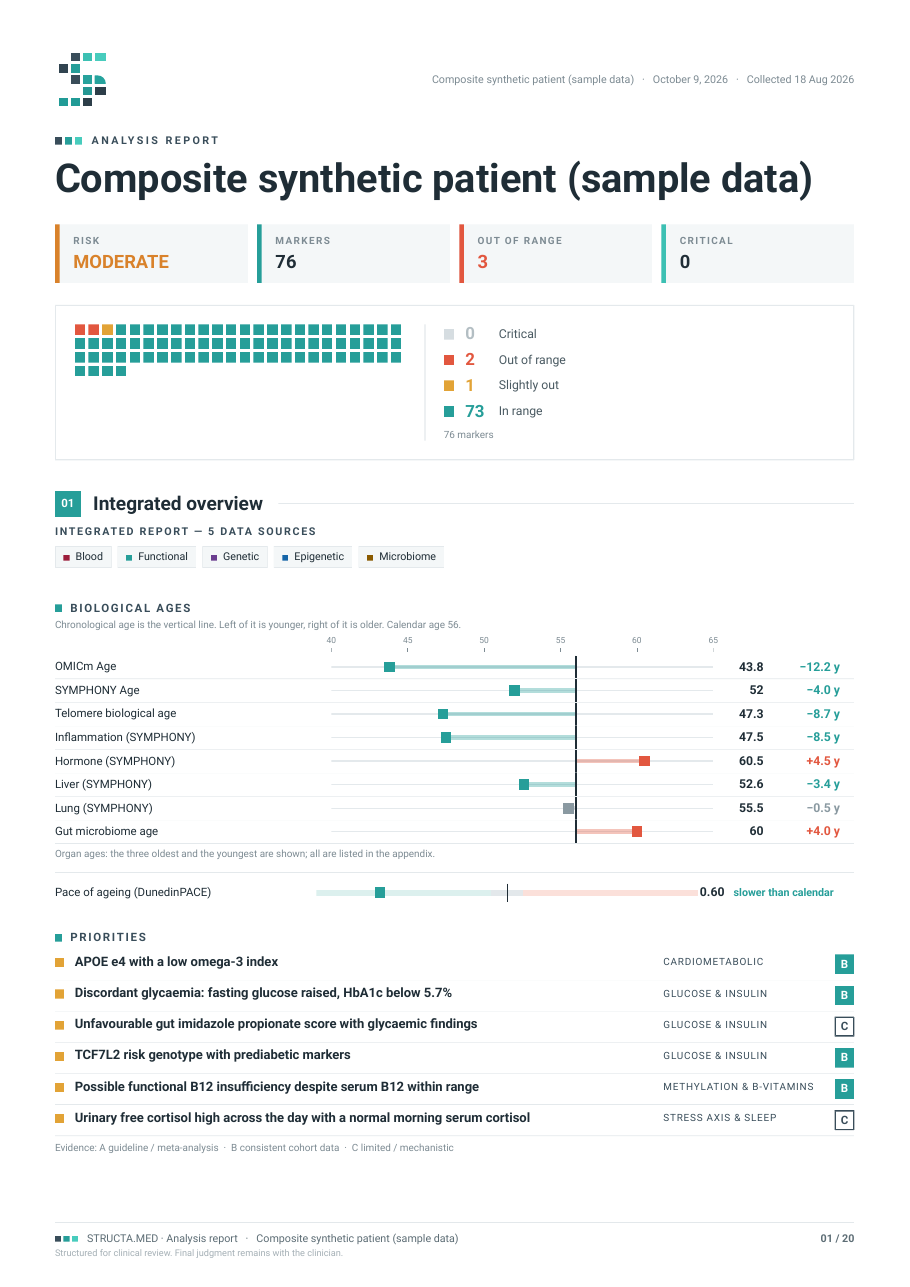
Send the results you already produce, from any of the 5 data types, in one API call. We read them together and return a single report: every statement names the test it comes from.
What we accept
- Blood chemistry
- Functional panels: urine, saliva, stool, hair, breath (~700 analytes)
- Genetics: SNP panels, pharmacogenomics, monogenic
- Epigenetic clocks and organ ages
- Gut microbiome scores
What you get
- Biological-age overview against chronological age
- Priorities, ordered, on the first page
- Findings by body system, with the source test behind every statement
- Evidence grade A, B or C on every genetic or cross-test statement
- Full appendix by source test; white-label PDF and JSON through the same API
betaThe omics field of the API is in beta; names and limits may still change.
Talk to usYour name on the report
PDF reports carry your laboratory's logo and display name in one of 12 colour palettes, and the StructaMed branding can be removed; the clinician disclaimer always stays. For the API we set this up in your partner profile; in the web application it is under Settings, PDF export.
Clinical governance and data
- A deterministic, rule-based engine: the same input always produces the same output.
- Every finding carries its reasoning: which markers, values and thresholds led to it, so a clinician can verify it.
- AI-written text exists only in the web application, where it is visibly labelled as AI-generated. The partner API makes no AI calls.
- The partner API does not store submitted results. It processes the request and keeps only a per-key count of calls for billing.
- Report text and individual result values are not written to production server logs.
- The server runs in Germany (Frankfurt) and the database in Switzerland (Zurich). Data is encrypted in transit and at rest.
- We recommend sending de-identified data only: an internal ID, sex, age and the results.
STRUCTA MED is decision support for clinicians. It does not diagnose and does not replace clinical judgement.
Start with a paid pilot on your panel
Choose one of your own panels, run it through the engine, and let your clinicians check the output against their own judgement. Tell us about your laboratory and we will agree the scope of the pilot together.
Contact us about a pilot